Cardiff Nature
Through the Nature Recovery Action Plan public consultation it became clear that hedgehogs are a key species of concern for people in Cardiff. Cardiff Local Nature Partnership, working with Cardiff University, joined the UK National Hedgehog Monitoring Project, making Cardiff the first project site in Wales. Two areas were surveyed with the help of volunteers in summer 2024.
Hedgehog populations are known to have undergone considerable declines in recent years and are now listed as ‘near threatened’ on the Conservation of Nature’s red list.
The UK National Hedgehog Monitoring Project (NHMP) aims to identify where and why hedgehogs are struggling and implement appropriate conservation measures. The NHMP will produce reliable estimates of hedgehog numbers that will allow a look at regional and habitat differences, and detect changes over time.
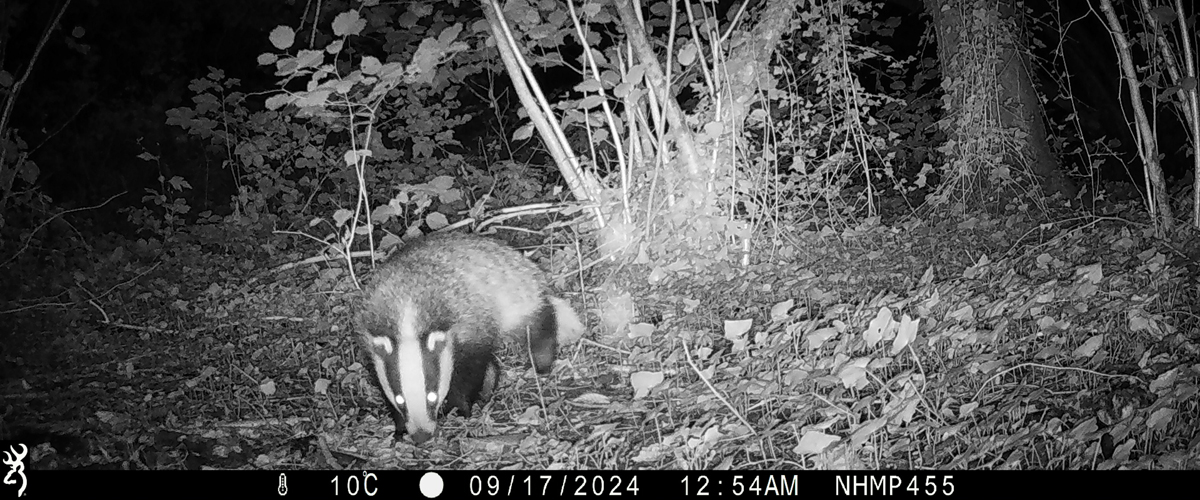
Using a network of cameras deployed at survey sites to capture images of hedgehogs and other animals, the NHMP team apply innovative methods to analyse the images and calculate population densities.
Joining the NHMP provided an opportunity to gather some quantitative data on hedgehog populations in Cardiff and develop local actions to support them.
The surveys involved setting up wildlife cameras at 30 locations in a grid pattern within a km square. The cameras were placed around 30cm from the ground, ideally placed to capture hedgehog movements. The 30 wildlife cameras, cases and locks required were purchased using Local Places for Nature funding.
The first survey site was based around Bute Park and the Cardiff University campus in Cathays. The second site was based around Forest Farm in Whitchurch.
The cameras were left to run for 30 days to capture images of hedgehogs and other wildlife, then retrieved and the images uploaded to MammalWeb at www.mammalweb.org/en.
Camera set-up and retrieval sessions were offered as a volunteer opportunity. The NHMP team delivered 2 volunteer training sessions to introduce the survey, demonstrate how to set up the cameras and how to analyse the footage on MammalWeb. Staff and 18 volunteers set-up the cameras in Cathays, staff and 12 volunteers set-up the cameras at Forest Farm.
The survey generated over 80,000 images which were run through an Artificial Intelligence programme to filter out pictures of humans and blank images.
The remainder (around 43,000 images) were made available on MammalWeb where volunteers are encouraged to look through the images and identify the species present. This is a crucial step to identify which of the images contain hedgehogs and therefore need further analysis.
To date over 300 volunteers have registered on MammalWeb to become a ‘spotter’ and helped to analyse the camera footage. So far around 12,000 images have been checked. Being able to contribute to a nature project online has broadened accessibility and enabled wider participation.
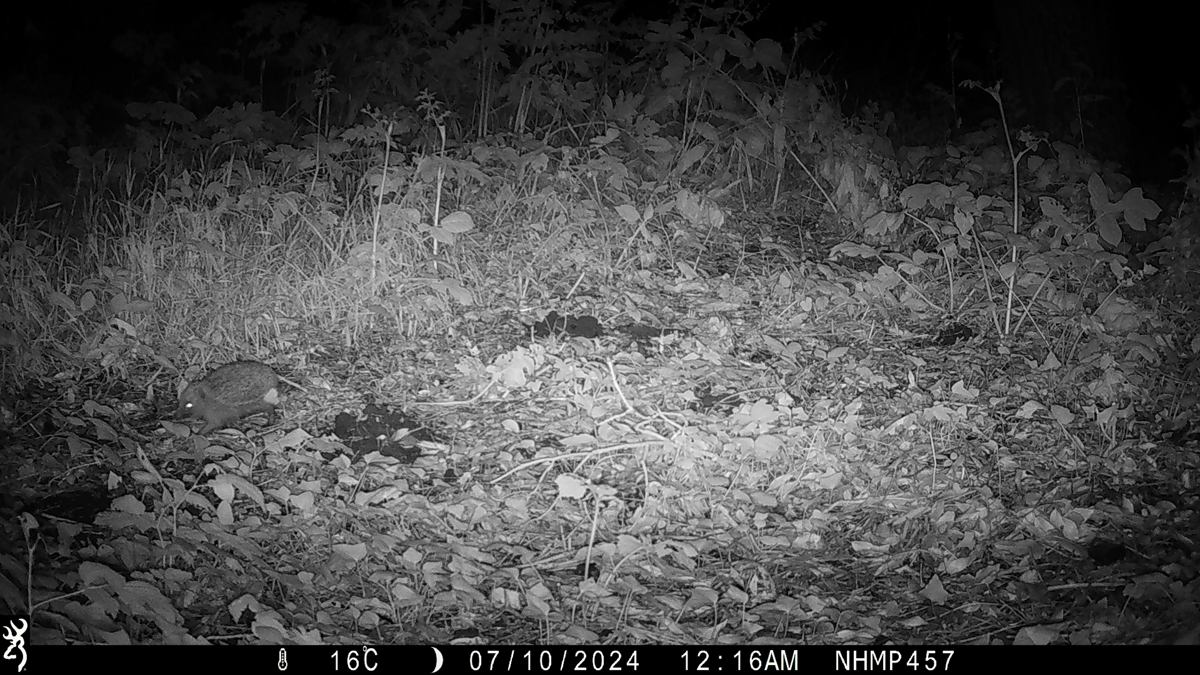
The project identified hedgehogs at both sites. In Cathays, 19 species of bird and mammal have been spotted so far (excluding livestock, dogs, cats and people). Woodpigeon appears on the most cameras (17 of the 30 cameras). Grey Squirrel and Red Fox are the next most frequently spotted species. So far, hedgehogs have been spotted at 10 cameras, making them the 5th most spotted species across the site.
At Forest Farm, 34 species of bird and mammal have been spotted so far (excluding livestock, dogs, cats and people). Red Fox appears on the most cameras (27 of the 30 cameras). Grey Squirrel and Woodpigeon are the next most frequently spotted species. Hedgehogs have been spotted at 3 cameras so far, making them the 15th most spotted species across the site.
The surveys were repeated in Cathays and Forest Farm in 2025 and a third site based around Heath Park was added. Following this, the team at Mammal Web will use the footage to estimate population numbers using both 2024 and 2025 results.
The main challenges of this project were having cameras positioned in busy urban locations, especially around Cathays. The high footfall meant some of the memory cards in the cameras filled up very quickly and so were not in action for the full 30 days.
This project has generated valuable data on the target species, the hedgehog, but also on other mammals and birds living at these sites. This information will be used to inform site management.
2026 LNP Cymruwebsite by WiSS